

Roberto Bianchi, legendary Strength and Conditioning Coach of Pallacanestro Cantù, tells how the team cut injuries by more than 70%—a breakthrough that led to one of the world’s most widely read scientific studies, ranked by Altmetric.
Delos Riva Method Specialist: Roberto Bianchi (Pallacanestro Cantù)
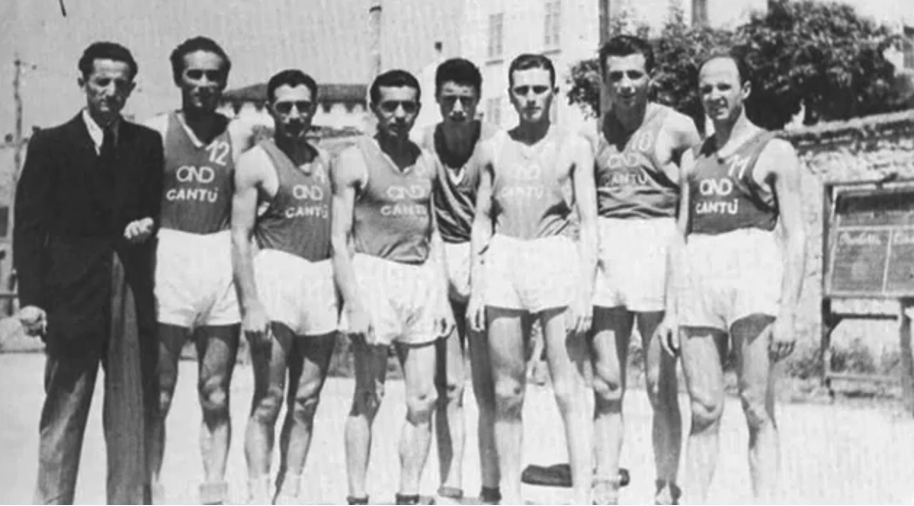
For basketball fans, Cantù is more than a team: founded in 1936, it is one of the most decorated clubs in Italy, legendary in the ’70s and ’80s with champions like Marzorati, Recalcati, Riva, and Bianchini.
During the 2004/05 season with Pallacanestro Cantù, American forward Shaun Stonerook was the heart of the team—an explosive rebounder and dunker with an extraordinary vertical leap. But like many basketball players, he was plagued by recurring ankle sprains that left him playing in fear and holding back his full potential.
During the 2004/05 Italian League season, I served as the team’s Strength and Conditioning Coach. While no longer at the peak of its golden years, the squad still competed at a high level and featured the great Shaun Stonerook, a powerful American forward. Shaun was a rare talent—a hidden playmaker around whom the team often revolved. One of his explosive qualities was his dominance on rebounds and his powerful dunks, fueled by an extraordinary vertical leap.
But basketball is an “ankle sprain sport.” Players learn to live with twisted ankles, and unfortunately, Shaun suffered repeated sprains that kept undermining his game.
It was then that I listened to the advice of my wife Erica, who at the time was a physiotherapist for the women’s national basketball teams. She was determined to buy what she described as a revolutionary tool for the prevention and treatment of lower-limb injuries: one of the first models of the Delos Postural Proprioceptive System (DPPS).
To be honest, at first I wasn’t impressed. I couldn’t imagine it would make a real difference in Shaun’s situation. But I was about to change my mind—completely.
After yet another ankle sprain, we simply couldn’t get Shaun back on the court in acceptable condition. Fearful of re-injury, he felt his ankles were unstable and played as if with the “handbrake on.”
That’s when Erica suggested testing him on the DPPS. Using Riva’s assessment protocols, it became clear that his ankle instability was severe.
Shaun was not only an incredible athlete but also a dedicated worker. He immediately understood that High-frequency Proprioceptive Training (HPT) could help him. And it did.
From that moment on, he never suffered ankle problems again—not that season, nor the following one, still with Cantù. And he was just the first of many players we trained with the Riva Method. Andrea, Phil, Jerry, Manu, Tony, Gianluca, Denis, Michele—so many of our guys benefited greatly, including an American player recovering from a devastating knee injury who went on to finish the season without major issues.
Over the following years, High-frequency Proprioceptive Training with Delos became a cornerstone of our physical preparation program. Traumatic injuries dropped by more than 70%—an extraordinary result. Far more than an insurance policy, it was true protection for the health of our athletes’ joints.
The scientific details of this remarkable experience were later published in the Journal of Strength and Conditioning Research, the official journal of the prestigious NSCA (National Strength and Conditioning Association).
After my experience with Cantù, I dedicated myself to training athletes for return-to-play after injury. I continue to follow the Riva Method and use the Delos system, which has been further refined over time in both mechanics and software.
“Sam” Bianchi is back. And with him, in just two years, Pallacanestro Cantù has returned to Serie A.