
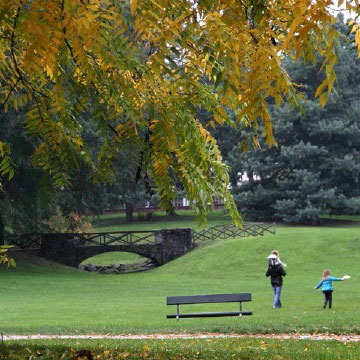
Arianna’s parentsshare how, three years after their daughter suffered a cerebral hemorrhage, they met Dr. Riva by pure chance during a family walk in the park. Balancing effortlessly on the low wall of a small bridge, he was performing an exercise so difficult that it immediately caught their attention. That unexpected encounter opened the door to the Riva Method and the Delos system.
What began with skepticism soon turned into hope—and then into real results.
Delos Riva Method Specialist: Alessandro Nebbiai (Centro propriocezione – Torino)
It was a mild Sunday morning in May. Our children—a girl and a boy, ages 9 and 6—had suggested a bike ride in one of the nearby parks. In the end, we chose Parco della Pellerina. Since we usually spent our weekends in the mountains, parks weren’t our usual destination, and this was actually the first time we had gone there since Arianna began her long rehabilitation journey, following the cerebral hemorrhage that struck her at age six.
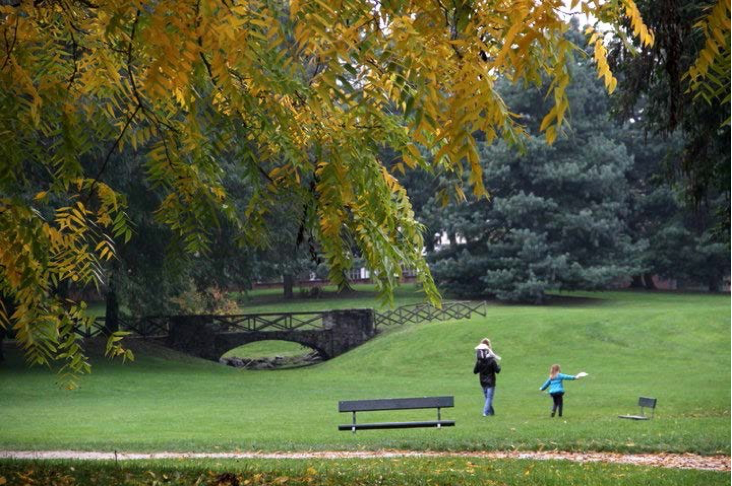
The little bridge in the Pellerina Park
Ready to go, the kids took off on their bikes while we parents ran behind. Along one of the park’s paths, our attention was caught by a man who, with remarkable agility, leapt onto the low wall of a small bridge. Balancing on one leg, he squatted all the way down and back up with ease. We were all impressed, children included, by how effortlessly he performed such a difficult exercise.
As we continued, the kids wanted to try jumping over small obstacles. It was at that moment that the man approached me, introducing himself as a sports physician and pediatrician specializing in movement and motor recovery. Having noticed my daughter’s difficulties, he thought he might be able to help. Surprised, I found myself telling him Arianna’s story—how the hemorrhage had caused left-sided hemiplegia, and how, on the advice of her physiotherapists, she wore a brace up to just below the knee to prevent her foot from dropping while walking. That man was Dr. Riva, the creator of the Riva Method and the Delos system—an innovative tool for assessing and retraining motor skills.
Although part of us feared we had stumbled upon yet another “miracle seller,” the desire not to overlook even the smallest opportunity—and perhaps a sense that fate was offering us a second chance—convinced us to meet with him.
At our first appointment, in a calm but confident tone, he explained that the brace was likely doing more harm than good and gave us the information we needed to understand his method. We scheduled another session, this time with our daughter, so he could carry out a clinical and functional evaluation to see if his approach could help in her case.
The first impressions were very positive. Like most children, our daughter found traditional physiotherapy boring, but hearing that this might allow her to stop wearing the brace—which she hated with all her heart—was enough to convince her to continue.
Her recovery program began with two sessions a week, eventually settling into one per week, a rhythm she still maintains today. Since starting therapy, she has made remarkable progress. Not only has her use of the leg improved significantly, but her overall condition has changed: the color and temperature of her foot, once cold and bluish, returned to normal. Most strikingly, the shape of her foot transformed. After the hemorrhage, her heel had shifted inward (varus) and the foot had curved inward as well, forcing all her weight onto the outer bones (the fifth metatarsal) and causing large calluses to form.
Through this methodology, her foot gradually regained its normal shape thanks to the reactivation of muscles that had been too weak after the lesion to counterbalance the opposing muscles. The Riva Method effectively “trained” those weakened muscles until they were strong enough to resist the pull of their antagonists.
These results have improved the fluidity and security of her movements in daily life—especially in play, walking, and sports like skiing.
And the future? I’m convinced that if my daughter were more determined, she could achieve even greater results (teenage years don’t make it easy!). But looking back, I realize that even having such a thought is proof of a success that, not long ago, we wouldn’t have even dared to hope for.
Delos Riva Method Specialist: Alessandro Nebbiai (Centro propriocezione – Torino)