

What is it?
Parkinson’s disease is a slowly progressive neurodegenerative disorder that primarily affects movement control and balance. It belongs to a group of conditions known as movement disorders and is the most common among them.
The symptoms of Parkinson’s disease may have been recognized for thousands of years. Early descriptions have been found in Indian medical texts dating back to around 5,000 B.C., as well as in Chinese documents from about 2,500 years ago. The condition, however, takes its modern name from James Parkinson, a London surgeon-apothecary of the early 19th century, who first described its main features in his famous essay “An Essay on the Shaking Palsy.” Parkinson died in 1824, and no portraits or photographs of him are known to exist.
Causes
The exact cause of Parkinson’s disease is still unclear. One theory suggests that it is linked to the abnormal accumulation of a protein called alpha-synuclein, which normally plays a role in communication between nerve cells. These protein deposits, known as Lewy bodies, can build up in different regions of the brain, especially the substantia nigra (a deep brain structure), interfering with normal brain function.
Lewy bodies are also found in other parts of the brain and nervous system, and are believed to contribute to additional neurological conditions. For example, in Lewy body dementia, they form in the outer layer of the brain (the cerebral cortex). They are also thought to be involved in Alzheimer’s disease, which may explain why about one-third of people with Parkinson’s also show Alzheimer-like symptoms.
Genetics also play a role: about 15–20% of people with Parkinson’s have a family history of the disease, suggesting a hereditary component in at least some cases.
Diagnosis
A diagnosis of Parkinson’s disease is likely if a patient presents with:
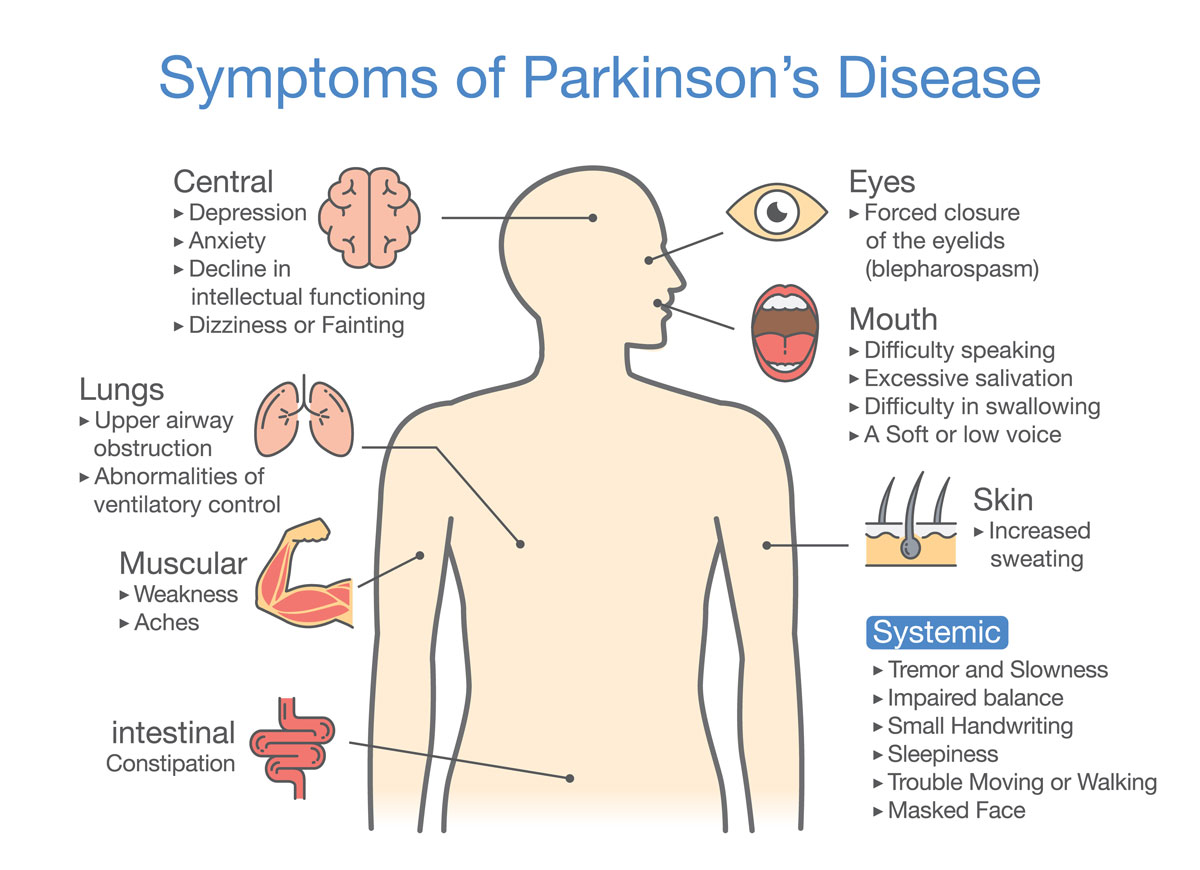
- Reduced and slowed movements (bradykinesia)
- Characteristic tremor
- Muscle rigidity
- Clear and sustained improvement with levodopa treatment
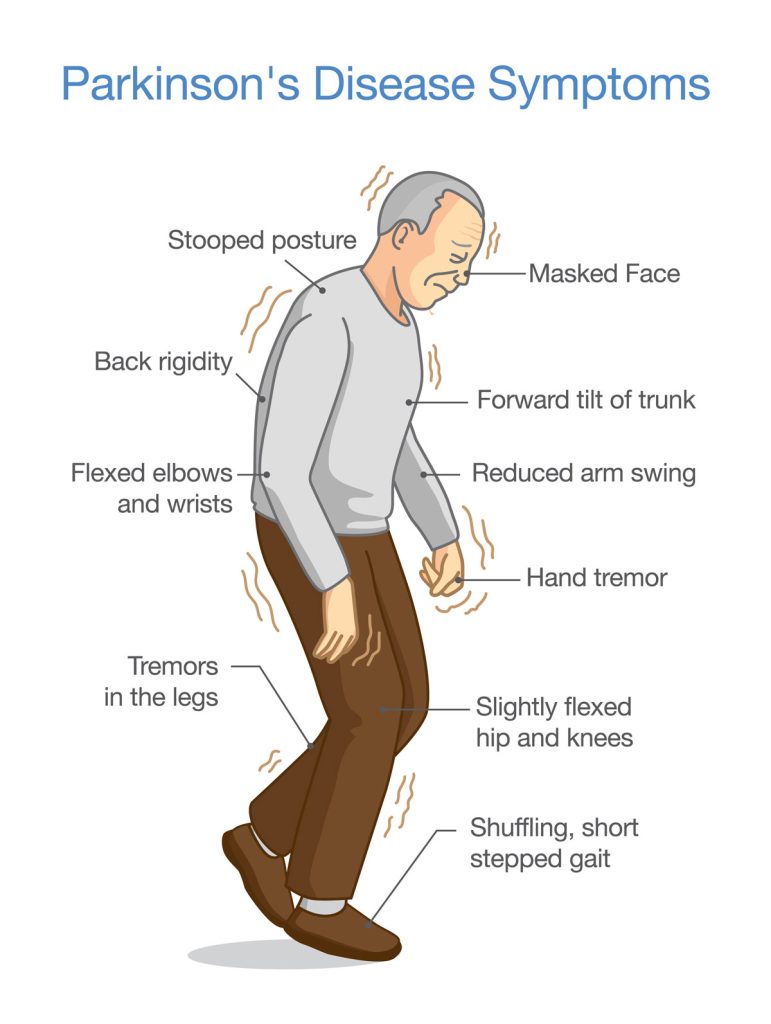
Diagnosing Parkinson’s in the early stages can be challenging, since symptoms often appear gradually and subtly. It is particularly difficult in older adults, as aging itself causes issues similar to Parkinson’s—such as balance problems, slowed movements, muscle stiffness, and postural instability.
Additionally, essential tremor is sometimes mistaken for Parkinson’s.
To rule out other possible causes, doctors carefully review the patient’s medical history, past illnesses, exposure to toxins, and use of medications that might induce parkinsonism.
Treatment
The main goal of Parkinson’s treatment is to restore dopamine activity in the brain, specifically in the striatum, by mimicking normal physiological stimulation.
The most effective therapy is levodopa, a precursor of dopamine. Unlike dopamine itself, which cannot cross the blood-brain barrier, levodopa can enter the brain, where it is then converted into dopamine.
Levodopa is highly effective in improving motor symptoms such as tremor, rigidity, and slowed movement. However, long-term use is often associated with dyskinesias (involuntary movements), which is why doctors usually delay starting levodopa therapy for as long as possible.
Unfortunately, current treatments are symptomatic only. They improve quality of life and motor function but cannot halt or reverse the progression of the disease.

The Role of the Riva Method in Parkinson’s Disease
While medications address the neurochemical imbalance in Parkinson’s, they do not prevent the gradual decline in motor control, balance, and stability. This is where the Riva Method offers significant value.
The Riva Method focuses on activating the body’s functional reserve through proprioceptive training and postural reprogramming. By stimulating reflexive stability and strengthening anti-gravity movements (such as standing up, walking, or climbing stairs), the method helps patients improve gait efficiency, reduce fall risk, and maintain independence for a longer period of time.In Parkinson’s disease, where motor automaticity is progressively lost, the Riva Method provides a way to restore motor effectiveness and safety by enhancing neuromuscular coordination and stability. While it is not a cure, it represents a powerful complementary approach that supports pharmacological therapy, delays disability, and improves overall quality of life.